Don’t Hire Smart People. Hire Smart Learners | Inc.com

IMAGE: Getty Images

Warren Buffet once said “In looking for people to hire, look for three qualities: integrity, intelligence, and energy. And if they don’t have the first one, the other two will kill you.” Clearly integrity is the first requirement when hiring, but right behind it, is intelligence. Unfortunately, intelligence comes with its own baggage.

Intelligence is essential when hiring into a fast growing company. Intelligence enables quick problem solving and brilliant, innovative ideas. Intelligence allows people to work autonomously when they need to cut through to the solution at a faster pace while still arriving at a great result. Smarter employees take less time to train and less time to positively impact your business.

However, smart people can also have a hard time learning. Chris Argyris‘ 1991 article in the Harvard Business Review, “Teaching Smart People How to Learn” outlines the basic dilemma and ways to think about solving it (It’s a must-read in my opinion). The dilemma is, the smartest people in the organization who are often assumed to be the best at learning, may actually not be very good at it. Read more…


6 Ways to Learn About a Company’s Culture – US News

Co-workers listening to each other at a team meeting

6 Ways to Learn About a Company’s Culture

How to tell if a prospective employer is a fit for you.

When you’re in the office of a prospective employer, look around at current employees. Do they seem enthusiastic and collaborative?

By June 3, 2015 | 10:51 a.m. EDT + More

You want to do work you enjoy alongside people you like. Your happiness and success depend on both. In short, you want to find a place to work where you feel you belong.

It comes down to finding a company with the right culture for you. Company culture is a hot topic among companies and individuals, but it can be difficult to define.

So what is company culture?

The best way to describe it is to talk about the “artifacts of culture,” or the examples of culture, says Josh Bersin, founder and principal at Bersin by Deloitte, a provider of research and advisory services focused on corporate learning. Culture can be represented by the company’s facilities, charismatic executives annual events or awards received.

And as difficult as it is for a company to define its culture, it’s even more challenging for a candidate to learn about it. Bersin says the best way to discover the authentic company culture is to observe it:  Read more…

How to Decide to Accept a Job Offer – 05-06-2015 : METRO in New York, NY US METRO


by Ellen Mehling, Career Development Consultant, METRO

 
We recently discussed how to decide to leave your current job. At some point in your career, you’ll find yourself facing the opposite decision, too, perhaps because you decided to leave a former position: whether or not to accept a job offer. Some of the same factors should be taken into consideration as when you’re deciding to resign, but there are additional components to consider, too.


20150505_How_to_Decide_to_Accept_a_Job_Offer.jpgFirst, be really honest with yourself throughout your decision-making, and make sure your choice comes from your own needs and preferences and not anyone else’s.


You can consult others and seek their advice (in fact, that is recommended), but remember that your advisors won’t be suffering the consequences if you make the wrong decision. While it is best to avoid making big decisions in a hurry, in most cases you will only have a couple of days or maybe a week from the initial offer, through negotiations, and to a “yes” or “no” from you to the employer.


Even if the offer sounds at first like it is just what you want, always ask for a few days to think it over, and then use that time to examine every aspect of the offer. Don’t say “yes” just because of a salary that makes you smile or because you have been unemployed or underemployed and at last you’ve been offered the full-time position you have wanted for a while.


Some things to consider:


  • Is the job description clear? Is it what you want to do, what you enjoy doing, and what you are good at? When you think of where you want to be in five years, or ten years, is this job keeping you on the road to that goal?

Read more…


3 Reasons Why You Can’t Get a Promotion

It happens to the best of us. You did not get the promotion you wanted and think you deserved. This hurts, it is frustrating, but it is not a career ender. You can choose to mope and get angry, or you can learn from this experience by taking a look at yourself and the situation to figure out the reason you were skipped over.

Here are three common reasons even the most talented, qualified professionals can’t get a promotion. Read more….

3 Reasons Why You Can't Get a Promotion

How to become a master networker – Business Insider

If your concept of networking is going to a cocktail party and exchanging a stack of business cards with strangers you’re not actually interested in, then you’re doing it wrong.

Building meaningful connections with smart, talented people across industries and job functions can lead to valuable client relationships, future job offers, and greater influence.

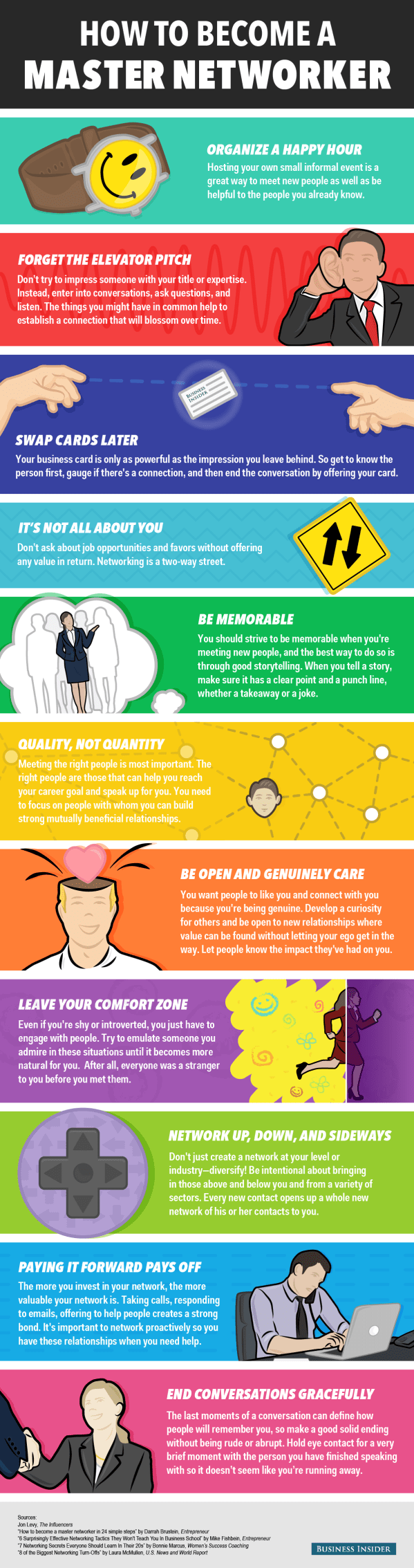
In the graphic below, we’ve gathered some tips from master networkers like Wharton professor Adam Grant, Influencers founder Jon Levy, and Women’s Success Coaching founder Bonnie Marcus.

Whether you’re an introvert or extrovert, these proven tactics will help you connect with anyone.

How to become a master networker - Business Insider