On the heartbreaking difficulty of getting rid of books

Astack_of_booksApril 26, 2016  By Summer Brennan

Like a lot of avid readers, I enjoyed Marie Kondo’s The Life-Changing Magic of Tidying Up but bristled when it came to the section about books. The gist of her now-famous method is this: go through all your possessions by category, touch everything, keep only that which “sparks joy,” and watch as your world is transformed. It seems simple enough, but Kondo gives minimalism the hard sell when it comes to books, urging readers to ditch as many of them as they can. You may think that a book sparks joy, she argues, but you’re probably wrong and should get rid of it, especially if you haven’t read it yet.

Paring down one’s wardrobe is one thing, but what kind of degenerate only wants to own 30 books (or fewer) at a time on purpose? What sort of psychopath rips out pages from their favorite books and throws away the rest so they can, as Kondo puts it, “keep only the words they like?” For those of us for whom even the word “book” sparks joy, this constitutes a serious disconnect. Still, as the weather gets warmer, many readers will tackle their spring cleaning with The Life-Changing Magic in hand.

I wondered, can Kondo’s Spartan methods be adapted for someone who feels about books the way the National Rifle Association feels about guns, invoking the phrase “cold dead hands”? I decided to give it a try. Read more…

4 TED Talks That Help Librarians Explain the Magic of Libraries

Since 2006, millions have been inspired by TED Talks: short, inspirational and educational videos by speakers expounding on topics from science to spirituality to dance. TED stands for technology, education and design, and its stated mission is to spread ideas.

The talks are often thought provoking and the speakers passionate about their topics. None last more than 18 minutes.

While a pleasure to watch, the videos also can provide librarians with a jumping point for their own blog posts and public talks.

Here are four TED Talks that you can use to help explain the magic of your public library.

Lisa Bu, How Books Can Open Your Mind

Lisa Bu is the content distribution manager for TED. In her talk, she shares details about her early life in China, and how, after moving to America, she turned to books to “expand her mind and create a new path for herself.” She used comparative reading to develop a better understanding of many subjects.

“Compare and contrast gives scholars a more complete understanding of a topic. So I thought, well, if comparative reading works for research, why not do it in daily life too? So I started reading books in pairs.”

 How to use it: This is a great opportunity to recommend and promote the public library’s collection. For example, you can build on Ms. Bu’s reading list. Or create your own “compare and contrast” book pairs. The opportunities are limitless, and this could become a regular series for your public library blog.  Read more…


Continue reading

14 Things That Impact The Quality Of Your Personal Brand

Quality and personal excellence are two key elements of your personal brand. The degree to which you fully embrace the importance of these elements is communicated to others on a continuous basis and is incorporated into others’ vision of who you are (i.e. the personal brand that you broadcast).

RELATED: The Perfect Recipe For A Great Personal Brand

Those who are fully aware of this fact can definitely undertake action to broadcast a personal brand that elevates their professionalism through conscious focus on quality and personal excellence.

Here are 14 things that impact the quality of your personal brand:

  • Every e-mail message you send to someone else.
  • Every voicemail message you leave for someone.
  • The voicemail message others hear when they try to reach you.
  • Your e-mail “signature.”
  • Read more…

10 Non-Negotiable Traits Your New Hire Must Possess

BY YOUNG ENTREPRENEUR COUNCIL
getty_482232067_9706529704500157_88207

IMAGE: Getty Images


Want a shot at landing your dream startup gig? While having a polished resume and company connections can help get your foot in the door, it’s your ingrained character traits that will likely determine your ability to thrive and make an impact on the business you’re so eager to work for.

Ten entrepreneurs from Young Entrepreneur Council (YEC) share qualities they believe all new hires must possess in order to land a coveted position in their business.

1. Adaptability

The Internet space changes so quickly that what worked even two years ago may not work now. The best employees are not necessarily the most experienced, but are rather those who can learn the new rules of the game the quickest. Usually these people are smart, creative, have an insatiable love of learning and are always striving to improve their game.–Charlie Graham, Shop It To Me, Inc.

2. Coachability

I’ve found that with the right hire, new skills and procedures can be easily learned. That willingness to learn new things and forget old ways, however, will probably never change. That’s why I look at a new hire’s coachability first, and their previous knowledge second.–Elle Kaplan, LexION Capital

3. Agility

In a startup, everything changes quickly — whether it is your product roadmap, skills of your employee, titles, or market/industry you are in. For example, in the last two years, we rewrote our whole product and changed the tech stack. It is very important that the new hire does not become stuck on what title and role she is looking for or a certain type of work she wants to perform. You should join a startup for the vision.–Shilpi Sharma, Kvantum Inc.

4. Respectfulness

Respect means a new hire will treat his co-workers, clients and others fairly and consistently. When a new hire has respect for differing opinions and positions, mutually agreeable resolutions can be discovered. Respect also means accepting the cultural, socio-economic and personal beliefs of others without letting those interfere with getting the job done.–Nicole Munoz, Start Ranking Now  Read more…

Who would be a librarian now? You know what, I’ll have a go

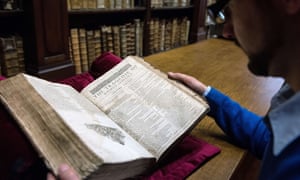
Remy Cordonnier, librarian in the northern town of Saint-Omer, near Calais carefully shows an example of a valuable Shakespeare “First Folio”, a collection of some of his plays, dating from 1623.

About the only drawback is dismissiveness from my friends and family. A working-class male taking a degree to be a what? Denis Charlet/AFP/Getty Images


“Who would want to become a librarian now?” asked an anonymous public servant on National Libraries Day, seeing before them a graveyard of dead libraries and old reference desks filled by volunteers. A valid question, and one to which I’ll reply: “You know what? I’ll have a go.”

I’m training to be a professional librarian, having just finished a lecture on “semantic web ontologies” and “linked data”, and sat dumbstruck in front of a “Dewey Decimal assembler” without a clue as to what I’m looking at. The course is challenging – it’s a three-year master’s degree that bites eye-watering chunks out of my wages. Why am I doing it to myself?

The fact is, I can’t not. It’s a sort of calling – like becoming a priest, only with warmer business premises. I can’t stand by and let public libraries sink. I won’t.

Forget all about reading as a pleasure, forget that children should have unlimited access to books, throw away arguments about libraries being lifelines for those less fortunate – they’re falling on deaf ears. You just have to look at the comments beneath pro-library articles to gather a general response: Kindles, the internet replacing information needs, and so on. And the one we wheel out about libraries being the centre of the community – there’ll be someone swatting that old classic aside with a “and yet the majority of the population doesn’t use them”. Read more…