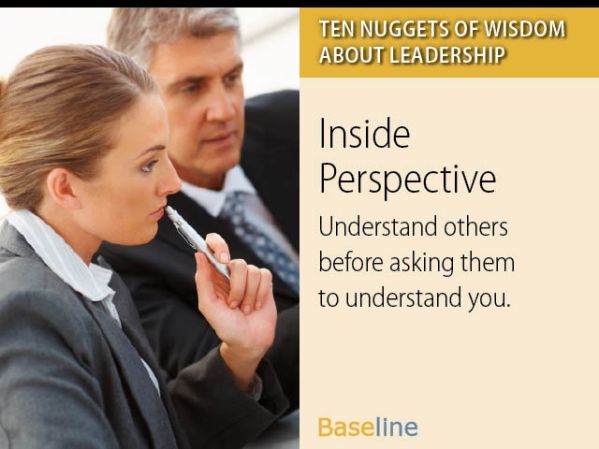
Dan Rockwell, author of the “Leadership Freak” blog
via Ten Nuggets of Wisdom About Leadership.

Home » LIS: Library and Information Science (Page 29)
Material that supports the study of how libraries and knowledge professionals are trained, how they share their skills, and how their peers view them.
Dan Rockwell, author of the “Leadership Freak” blog
via Ten Nuggets of Wisdom About Leadership.

At the core of your LinkedIn experience is your profile. As you complete it, you are prompted to include information for all of your educational background as well as companies and positions that you’ve held over the course of your career.
Sounds pretty much like a résumé, right?
Not so much.
LinkedIn is evolving and if you are a savvy job hunter, you will seize the opportunity to utilize its new features to your advantage


What Does It Mean to Be Professional at Work? – On Careers usnews.com.
You probably know that it’s important to be professional if you want to have a successful career, but what does that actually mean? After all, professionalism is rarely taught; you’re supposed to pick it up on your own through a combination of observation and osmosis, but that’s not always easy to do. And learning on the job can be fraught with land mines, since you might not even see your mistakes coming.
So without further adieu, here are 10 key elements of professionalism that you should master early in your career.
1. Pay attention to the cultural norms in your organization, and follow them. If you watch how others in your office operate, you’ll learn all sorts of important things about “how we do things here.” For instance, you might observe that everyone shows up precisely on time for meetings, that they modulate their voices when others are on the phone, and that people rely on email for non-urgent questions. These are important signals for what will be expected of your own behavior – and you’ll come across as tone-deaf if you ignore them. Read more…

The Future of Academic Libraries | Geeky Artist Librarian.
The two library-related questions I hear most are:
1) Will ebooks replace print books in the near future?
2) How is the digital revolution changing the mission of libraries; what will academic libraries become in the future?
The first question frustrates me on a number of levels, primarily because I hear it so often. The question is asked either in a tone of horror at the thought that the Era of No More Print Books is imminent, or with a bit skeptical cynicism, wondering who would choose to be a librarian in an age when you might soon become “irrelevant” (sigh). My pat responses are: this shift isn’t happening as fast as originally anticipated, print books continue to have lasting power beyond device lifetime and software upgrades, and ultimately the ebook format isn’t killing literature, it’s simply another format in which to digest the content of books. Cultures originally related stories and information orally before turning to stone and scrolls, then becoming books. Books have remained in essentially the same form for centuries because they are cheap, portable, and when printed on quality materials can be preserved for eons. However, stories and information will last beyond the medium of the print book. This is simply a change in format: like VHS to DVD to Blu-ray. Yes, there are other issues inherent in this conversation (for instance, the relative cheapness of a paperback to buying an ereader), but that’s as far as I want to get into that issue now. Read more…


 Stephanie L. Gross, MSLIS