Curb Your Librarian Frustration in 8 Steps – Stephen’s Lighthouse

It’s the start of a new month. Are you frustrated yet?  Is your job driving you crazy? Your boss? Your customers?  Are you thinking too much about quitting, retiring, vacationing, or abandoning your dreams?  Do you fantasize your hands around someone’s neck?

Now, before you fold your arms and stomp off into the sunset there is something you should know. This is normal. Every professional worth their salt and who has had an ounce of success has been there.   If you care, you get frustrated . . . and sometimes angry, demotivated or sad.  Worry when you’re at the point of “whatevah.”  Whenever you experience one of those moments (or weeks, months, etc.) you have to spend some time considering your choices and reconnecting to your passion.  Passion drives most of us – it’s what makes librarians put up with the pay! 😉 Luckily for the world, most of us choose to keep going and making a difference.

And you should too.  If no one has told you lately . . . you matter.  Librarians matter.  Information matters.

So, before you throw in the towel, or just wallow in the blues and self pity, let’s think about how to curb some of that frustration a bit so you can get back to striving for success, innovation, great client interactions, fame and fortune (well maybe not the fortune… tongue firmly in cheek).  Let’s move on and make a difference in the world. Read more…

Karen Kashmanian Oates, Ph.D.: The Importance of Basic Research

This is science’s newest Golden Age. Young people today are inspired by generational heroes like Steve Jobs and Mark Zuckerberg that were filled in the relative recent past by the likes of Michael Jordan and Mick Jagger. The fact that today’s students can dream of emulating role models who achieved their status using their minds and curiosity is a good thing.

However, there is one significant drawback. The rock star status of today’s scientific celebrities encourages aspiring scientists to focus on the retail possibilities that can result in fast fame and wealth. While understandable, this unwittingly neglects a crucial part of the scientific equation — basic research. Read more…

Why We Miss the First Sale Doctrine in Digital Libraries

By on March 8, 2013 Leave a Comment

From


This is the fourth in an occasional series of articles that will explore issues surrounding the efforts to launch and expand the Digital Public Library of America.


John PalfreyPublishers, ebook vendors, and libraries are engaged in a “tug of war” over the lending of electronic books, according to Library Journal’s recent ebook survey. This clash inhibits most libraries from fulfilling their important institutional missions to provide access to knowledge and preserve our cultural heritage. In the best case, this tug of war will be a temporary struggle. The best outcome is not a winner who holds all the rope and another lying on the ground with rope-burned hands. If there must be a winner of any kind, it ought to be the reading public.


In this article, the fourth installment in a series on the initiative to build a Digital Public Library of America, I examine the underlying role of law in the ebook lending debate, explore potential solutions to the problems, and consider how the DPLA can contribute to solutions for those we serve. At the core of this issue is the way the copyright law works–or doesn’t–when it comes to books, libraries, and readers in the United States today and into the future. Read more…


Enhanced by Zemanta

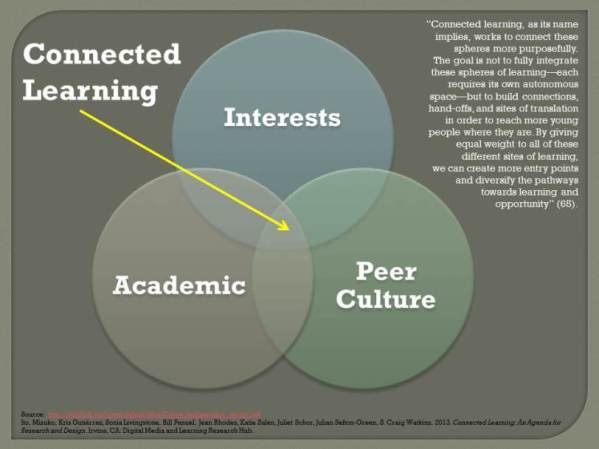
Connected Learning and Implications for Libraries as Spaces and Mentors for Learning

“Connected learning is realized when a young person is able to pursue a personal interest or passion with the support of friends and caring adults, and is in turn able to link this learning and interest to academic achievement, career success, or civic engagement.”
from Connected Learning:  An Agenda for Research and Design

For the last month or so, I’ve been dwelling in Connected Learning:  An Agenda for Research and Design, a research synthesis report that outlines the research and findings of the Connected Learning Research Network, a group chaired by Dr. Mimi Ito.  In addition to the report, I’ve enjoyed the series of recent webinars centered around the report: Read more…

Enhanced by Zemanta

Episode 104: Professor Sees ‘Moral Imperative’ for Open Access – Tech Therapy – The Chronicle of Higher Education

Podcast link : http://chronicle.com/blogs/techtherapy/2013/03/06/episode-104-professor-sees-moral-imperative-for-open-access/?cid=wc&utm_source=wc&utm_medium=en

March 6, 2013, 3:12 pm

David Parry

David Parry, an assistant professor of emerging media and communications at the University of Texas at Dallas, argues that scholars have an obligation to publish their research in journals that make free copies available online. The Tech Therapy team talks with him about how the debate over open access to research has heated up in recent months, and invites journal publishers to give their views on next month’s podcast.

Links discussed in this episode: Memorials for Aaron Swartz Turn to Discussion of How to Honor His Legacy | Knowledge Cartels v. Knowledge Rights

Each month The Chronicle’s Tech Therapy podcast offers analysis of and advice on what the latest gadgets and buzzwords mean for professors, administrators, and students. Join your hosts, Jeff Young, The Chronicle’s technology editor, and Warren Arbogast, a technology consultant who works with colleges, for a lively discussion—as well as interviews with leading thinkers in technology.

Enhanced by Zemanta