Career Transitions for Librarians : 5 Questions with Ray Pun and Davis Erin Anderson [INALJ]

by Naomi House, MLIS

career-transitions-for-librarians-inalj

In this post, I interviewed the co-editors of Career Transitions for Librarians and asked them 5 questions about the book!


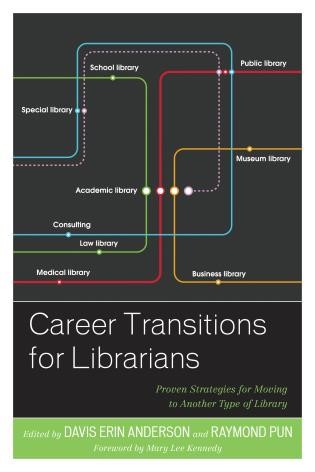
  1. Tell us about yourselves and your new book, Career Transitions for Librarians: Proven Strategies for Moving to Another Type of Library !

Ray Pun: Thanks for inviting us to speak about our new book! We are excited to be sharing what we think would be helpful to INALJ readers!

So I’m the first year student success librarian in Fresno State in California. I thought about this project in 2014 when I was writing a blog post for ACRL on career transitions. At that time I made a move from NYPL to NYU Shanghai and I thought this was an interesting transition; many colleagues asked how I did it and I tried outlining it in the blog with some tips. I started speaking to more and more library professionals and seeing how many used to work in corporate, public, school and academic libraries and I thought this would be a great story to tell. There has not been much literature about career transitions in our field and it’s time there should be one!


Davis: I work for a wonderful non-profit that’s a hub for librarians, archivists, and museums where we focus on the nexus all kinds of different library types. Read more…


The 1 Thing You Need to Achieve Work-Life Balance by Lolly Daskal

There is a secret to work-life balance, but you’re not going to like it.

How to Confront Conflict in the Workplace by Dennis McCafferty

posted 11-16-2015

confrontconflict_0

How to confront conflict in the workplace: CIOs and other managers too often focus on the personalities involved with a dispute instead of root causes, research shows.

When problems are dismissed or ignored, they fester and grow into bigger problems.

– See more at: http://www.cioinsight.com/it-management/careers/slideshows/how-to-confront-conflict-in-the-workplace.html#sthash.LkBUUOvQ.dpuf


It’s difficult to manage a conflict-free office: Strained relationships among employees account for no less than three out of five difficulties within organizations, research shows. Meanwhile, 43% of non-management workers feel that their bosses do not deal with conflict as well as they should. In covering this topic, the recent book, The Essential Workplace Conflict Handbook: A Quick and Handy Resource for Any Manager, Team Leader, HR Professional, or Anyone Who Wants to Resolve Disputes and Increase Productivity (Career Press/available now), defines the common sources of morale-sapping acrimony while providing best practices in addressing these disputes. Authors Barbara Mitchell and Cornelia Gamlem reveal that CIOs and other managers too often focus on the personalities involved with a situation instead of root causes. They also must understand that their personal approach in dealing with an issue weighs greatly in “making it go away”—or creating even larger problems. The following “conflict myths” and best practices are adapted from the book. Mitchell and Gamlem are HR consultants and co-authors of The Big Book of HR. – See more at: http://www.cioinsight.com/it-management/careers/slideshows/how-to-confront-conflict-in-the-workplace.html#sthash.LkBUUOvQ.dpuf

How To List Online Courses On Your Resume The Right Way (Because Yes, There Is A Wrong Way)

960x0

Shutterstock

So you’ve been taking some online courses. You’ve learned a ton, and you’ve even been using your new skills at work or to develop a side project.

But now you’re contemplating a career move and wondering how (and even whether) to include your continuing education on your resume. You’re right to approach this task thoughtfully. Online courses are still relatively new, recruiters can be skeptical and in certain cases, listing your online education can actually make your resume worse.

I spoke to several recruiters and hiring managers to gather insight on what they think when they see online courses listed on candidates’ resumes. So, whether you aced your marketing MOOC (Massive Open Online Course), killed it in coding bootcamp, or taught yourself graphic design, here are some of their tips on how to tell that story in your application:

1. Put Them In Their Proper Place

Across the board, the hiring managers and recruiters I spoke with agreed that MOOCs and other online courses can help make the case that you can do the job. However, they also think these classes shouldn’t be the star of the show. As Anne Lewis, the Director of Sales and Recruitment for Betts Recruiting, a firm specializing in recruitment for technology companies, told me, “In general, MOOCs can help to make candidate profiles stronger, especially junior candidates who don’t have as much experience.” Read more…

Skills college grads still need to learn to impress hiring managers