6 Changes You Should Make to Your Job Search by Hannah Morgan

It’s harder than ever to land a good job. So if you’re unemployed and searching for one, you’re probably frustrated. While employers cite many reasons why finding the right talent is nearly impossible, you can only control what you are doing (and not doing) to get on an their radar.

Here are a few things you should do differently to get more interviews.

1. Cut the time you spend on job boards. If you’re like most job seekers, you rely heavily on job boards and LinkedIn job postings as your primary sources to uncover job opportunities. This reactive approach is unlikely to result in an interview, because most employers rely on referrals to fill jobs with external candidates. And in reality, the majority of jobs are filled with internal candidates, and even if these positions were advertised, you wouldn’t stand a chance.

Job postings are great for mining information on the specific skills required for jobs. Postings can also help you identify potential employers (and competitors) who are known to hire for the types of jobs you are interested in. Once you’ve identified these companies, you can begin to find people you know or should know who work inside the company. This is how referrals happen.

Read more: http://money.usnews.com/money/blogs/outside-voices-careers/2015/07/01/6-changes-you-should-make-to-your-job-search?src=usn_fb Networking is Networking is crucial during a job search, but you must take the time to build meaningful relationships.

So You Got a Job Interview – What’s Next? Four steps that will ensure you wow your interviewer.

By March 30, 2015 | 9:53 a.m. EDT 

You finally got the call you’ve been waiting for: an invitation to interview for a job you’re really excited about. What do you need to do now to ensure you ace the interview?

Here are four steps that will position you as strongly as possible to wow your interviewer:

1. Research the company. It’s important to get familiar with the company you’ll be interviewing with. Understanding the context your interviewers are working in will help you have a more intelligent conversation.

This doesn’t mean simply memorizing facts about the company; there’s not a lot of utility in that. Rather, you’re looking for the answers to questions like these:

  • How does the company see itself? What would its employees say makes it different from its competition?
  • What is the company most known for?
  • Has it been in the news lately? If so, for what?
  • What are the company’s biggest current initiatives, projects, products or clients?
  • What info can you find about the company’s culture and values?
  • Roughly what size is the company?
  • Who are the company’s key players? What kind of backgrounds do they bring to their roles?

If you come across as someone with a baseline understanding of these basics about the company, your interviewers will much more easily picture you in the job. Conversely, if you don’t seem to know any of this information, they’re likely to wonder how interested you really are and whether you even really understand what they do. Research the company before interviewing. Try to find out how the company sees itself, what it’s most known for and who its key players are.

Read more:

http://money.usnews.com/money/blogs/outside-voices-careers/2015/03/30/so-you-got-a-job-interview-whats-next?src=usn_fb

3 Reasons Why You Can’t Get a Promotion

It happens to the best of us. You did not get the promotion you wanted and think you deserved. This hurts, it is frustrating, but it is not a career ender. You can choose to mope and get angry, or you can learn from this experience by taking a look at yourself and the situation to figure out the reason you were skipped over.

Here are three common reasons even the most talented, qualified professionals can’t get a promotion. Read more….

3 Reasons Why You Can't Get a Promotion

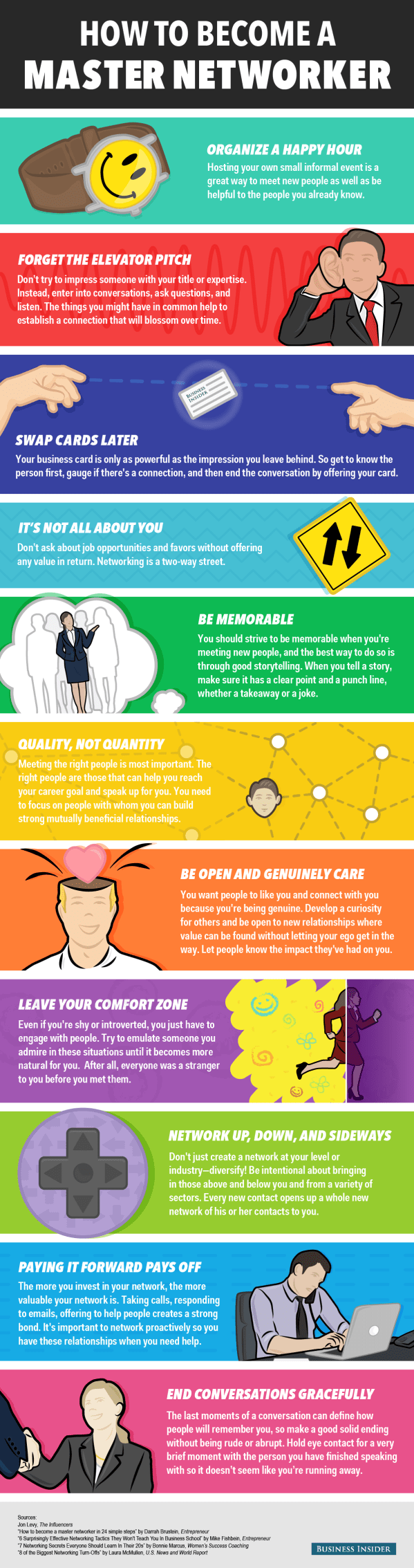
How to become a master networker – Business Insider

If your concept of networking is going to a cocktail party and exchanging a stack of business cards with strangers you’re not actually interested in, then you’re doing it wrong.

Building meaningful connections with smart, talented people across industries and job functions can lead to valuable client relationships, future job offers, and greater influence.

In the graphic below, we’ve gathered some tips from master networkers like Wharton professor Adam Grant, Influencers founder Jon Levy, and Women’s Success Coaching founder Bonnie Marcus.

Whether you’re an introvert or extrovert, these proven tactics will help you connect with anyone.

How to become a master networker - Business Insider


Avoiding Cinderella Syndrome: Why Every Job Doesn’t Have to be a ‘Perfect’ Fit | INALJ

by Krystal Corbray, Managing Librarian with Yakima Valley Libraries in Washington State
previously published 7/15/14


Krystal CorbrayOnce you’ve been job hunting for a while, things can get a bit…intense. Many job-seekers talk about their employment search as if it’s a full-time job—which is an admirable and, often, effective way to go about a job hunt.

It’s only when job-seekers start talking about their efforts while using phrases like “perfect fit” and “dream job” that things can start to head off track.

Why?

Because searching for jobs with an all-or-nothing mindset, like you’re looking for a soul mate, is a surefire way to severely limit your job prospects, and can also mean missing out on some perfectly good opportunities that don’t necessarily fit a checklist of ideal requirements for your dream job.

This isn’t to say that job hunters shouldn’t use a bit of discretion—there’s obviously nothing to gain from blindly applying for jobs simply because “library” or “information” appears somewhere in the description—but there’s definitely a great deal of value to be had by not being overly exclusive in your job hunt. Read more: http://inalj.com/?p=76760