8 Signs an Employee Is Exceptional (Which Never Appear on Performance Evaluations)

Many are good. Some are superior. And a few–just a few–are exceptional. Here’s how to tell the difference.

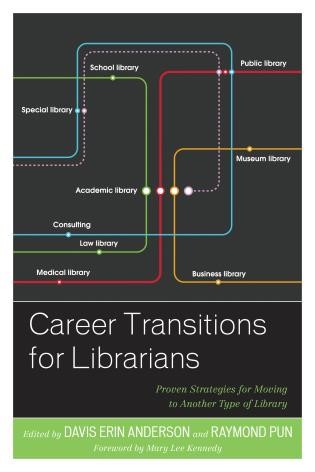
Career Transitions for Librarians : 5 Questions with Ray Pun and Davis Erin Anderson [INALJ]

by Naomi House, MLIS

career-transitions-for-librarians-inalj

In this post, I interviewed the co-editors of Career Transitions for Librarians and asked them 5 questions about the book!


  1. Tell us about yourselves and your new book, Career Transitions for Librarians: Proven Strategies for Moving to Another Type of Library !

Ray Pun: Thanks for inviting us to speak about our new book! We are excited to be sharing what we think would be helpful to INALJ readers!

So I’m the first year student success librarian in Fresno State in California. I thought about this project in 2014 when I was writing a blog post for ACRL on career transitions. At that time I made a move from NYPL to NYU Shanghai and I thought this was an interesting transition; many colleagues asked how I did it and I tried outlining it in the blog with some tips. I started speaking to more and more library professionals and seeing how many used to work in corporate, public, school and academic libraries and I thought this would be a great story to tell. There has not been much literature about career transitions in our field and it’s time there should be one!


Davis: I work for a wonderful non-profit that’s a hub for librarians, archivists, and museums where we focus on the nexus all kinds of different library types. Read more…


5 Hard Lessons I’ve Learned As A Career Coach

J.T. O’Donnell
June 14, 2016

how-to-become-a-6-figure-career-coach_thumbnail-1024x576

I’ve been a professional career coach since 2002. Over the last 10+ years, I have learned a lot about the industry and what it takes to be an effective career coach. [Click here to learn more about becoming a career coach.]

Back when I became a coach, the concept wasn’t as widely accepted as it is today. In fact, my clients were afraid to admit they were working with a career coach because they felt like it indicated there was something wrong with them. Today, we now understand career coaching isn’t a sign of weakness, but a path to greatness. It’s why all the top pro athletes and business executives use them. If you want to optimize your performance and achieve new levels of success and satisfaction in your career, it’s more than likely you’ll work with a coach at some point. Why? If you could do it on your own, you would have by now.

I Learned These Lessons The Hard Way

Having worked with literally thousands of people on their careers, I have learned some valuable professional lessons. In the beginning of my coaching career, I thought I could help everyone. I was wrong. You can only help people who are ready to be helped. I wasted hundreds of hours on people who just weren’t ready to succeed. I learned the hard way the following five things:

People only turn to career coaching when they are in pain.

School teaches us everything except how to manage our careers. As a result, nobody enters the professional world with the right set of skills and abilities to successfully manage their careers. Unfortunately, it isn’t until a person makes a major mistake or has a career setback that they seek coaching. Only then do they have the Ah-ha Moment that they need to close the gap in their knowledge and abilities so they can get back on track. Read more…

The 1 Thing You Need to Achieve Work-Life Balance by Lolly Daskal

There is a secret to work-life balance, but you’re not going to like it.

The progressive librarian: 10 ways to be more forward-thinking

by Sarah Tanksalvala

For librarians, being more progressive means embracing new ways of approaching their job and the role of the library in a university. Progressive librarians are working to revitalize libraries by making them more than simply places that store information. Part museum, part lab, progressive libraries are exploring and defining their services based on people’s needs.

“Librarians find themselves in the midst of trying to reinvent themselves and what they do,” says Sebastien Marion, virtual services librarian at New York Institute of Technology. “The challenge is how to go from book-storage places to collection places to places that engage with skills.”

Progressive librarianship has a number of defining components. Progressive librarians support reading culture, in an academic environment in which many are pushing for all-digital libraries. Progressive librarians support personal learning, and see the library as a place where personal learning and lifelong exploration can take center stage.

Here are 10 tips for librarians looking for ways to become more progressive.


1. Focus on the human component: Libraries might be seen as places to go work quietly, but progressive librarians look for ways to make libraries more human-centric. Read more…