Related articles
- Designing A Website: 30 Great Web Design Tutorials (cssmania.com)
- Weekly Web Design Inspiration #25 (downgraf.com)


Home » EdTEch: Educational Technology (Page 8)
Education and Technology meet both in and out of the classroom and library/information commons.

Gerald Haigh visits his alma mater to learn that a good attitude to technology correlates with good learning habits

Is there a digital native? Not according to new Open University research
A new research project by the Open University explores the much-debated concept of “the digital native”. The university does this by making full use of the rich resource which is its own highly diverse student body.
It concludes that while there are clear differences between older people and younger in their use of technology, there’s no evidence of a clear break between two separate populations.
Is there really a distinct group of younger people who are not only easy with technology because they’ve grown up with it, but actually think and learn differently as a result? The idea gained quite a bit of traction after Marc Prensky wrote about the idea ten years ago in Digital Natives, Digital Immigrants, with other writers weighing in, such as Bradley Jorgensen with Generation X and Generation Y.
Since then, the concept has often been questioned, and even Prensky’s own ideas have changed somewhat. The notion persists in the public imagination though. After all, it seems to bear the fatal hallmark of “common sense”. On one side of the divide is the young person who uses technology like she drives her car, without the need for conscious attention to the process. On the other side sits a grizzled and mature individual, maybe a would-be ‘silver surfer’, frowning impotently at a keyboard and calling for his granddaughter.
This isn’t, though, just a saloon bar debating point, or material for yet another Grumpy Old Men TV programme. If there really is a clear generational separation of brain process, then we need to know more about it because there are important implications for learning. Read more…

 This indeed is sad news.


GuitarLessons365Song/YouTube
My 15-year-old daughter has been playing the viola since the fourth grade at school and she’s been encouraged by her teachers to keep at it since, among other things, it’s marketable for college. She has been contemplating a new instrument, guitar, more in line with her interests and what she listens to with her peers.
This is how the conversation goes about the guitar. Me: “Do you really want to add a new activity?” Her: “We already have a guitar. I can learn on my own and with my friends.” Me: “It seems like you should get lessons for the basics.” Her: “Mom, that’s what the Internet is for.” It turns out she’s already been practicing with the help of YouTube tutorials. Read more…

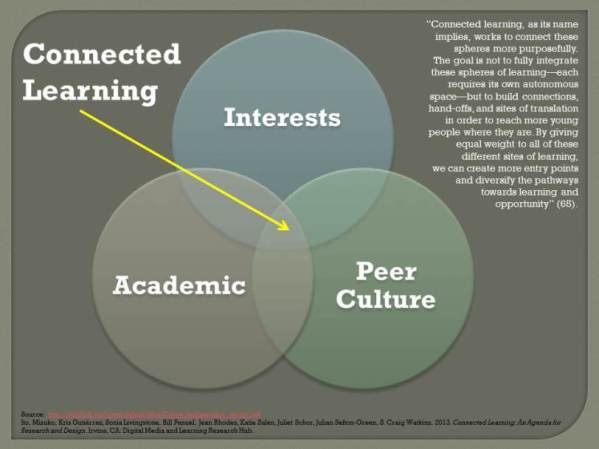
“Connected learning is realized when a young person is able to pursue a personal interest or passion with the support of friends and caring adults, and is in turn able to link this learning and interest to academic achievement, career success, or civic engagement.”
from Connected Learning: An Agenda for Research and Design
For the last month or so, I’ve been dwelling in Connected Learning: An Agenda for Research and Design, a research synthesis report that outlines the research and findings of the Connected Learning Research Network, a group chaired by Dr. Mimi Ito. In addition to the report, I’ve enjoyed the series of recent webinars centered around the report: Read more…

 Stephanie L. Gross, MSLIS