The Dying Art of Disagreement | Op-Ed

Freedom of Speech | Democracy | Public dialog

by Bret Stephens | September 24, 2017

24stephensweb-blog427

This is the text of a lecture delivered at the Lowy Institute Media Award dinner in Sydney, Australia, on Saturday, Sept. 23. The award recognizes excellence in Australian foreign affairs journalism.

Let me begin with thanks to the Lowy Institute for bringing me all the way to Sydney and doing me the honor of hosting me here this evening.

I’m aware of the controversy that has gone with my selection as your speaker. I respect the wishes of the Colvin family and join in honoring Mark Colvin’s memory as a courageous foreign correspondent and an extraordinary writer and broadcaster. And I’d particularly like to thank Michael Fullilove for not rescinding the invitation.

This has become the depressing trend on American university campuses, where the roster of disinvited speakers and forced cancellations includes former Secretaries of State Henry Kissinger and Condoleezza Rice, former Harvard University President Larry Summers, actor Alec Baldwin, human-rights activist Ayaan Hirsi Ali, DNA co-discoverer James Watson, Indian Prime Minister Narendra Modi, filmmaker Michael Moore, conservative Pulitzer Prize-winning columnist George Will and liberal Pulitzer Prize-winning columnist Anna Quindlen, to name just a few. Read more…

Competency Index for the Library Field 2014

Competencies | Career development | Library Skills

by Betha Gutsche and Brenda Hough, editors.

19 March 201521752988_10159605896755727_1299874495208785589_o


Looking to take your career to the next level? The Competency Index can help! See how 21st century skills, accountability, and community engagement can make a difference in your work. #WebJunctionWednesday http://bddy.me/2xfzafR

Using our words: Getting it right on neutrality and libraries

Intellectual Freedom | Neutrality in libraries

by Joseph Janes | American Libraries | 09-01-17

I’ve always been a wordy sort of person. Yes, that too, but I mean word-y. I was the sort of kid who spent time with a thesaurus and dictionary as well as Tinkertoys and Matchbox cars. I was fascinated by words, their uses, and shades of meaning.

Even my amateur lexicographic interest ill prepared me for a world in which one of the more trenchant voices of political observation belongs to the Merriam-Webster Twitter feed (@MerriamWebster). If you don’t follow it yet, do so immediately, for its largely straightforward Word of the Day feature as well as its often wry and acerbic commentary on trending lookups based on “conversations” of the moment, not to mention words that aren’t really words (“covfefe”).

So the Webster’s dictionary has taken a side, or at least a perspective. Based on what I know of Noah Webster’s own colorful history and antipopulist views, I think he might approve. All of which puts an intriguing gloss on an emerging discussion within our own profession on what some may think a bedrock principle of librarianship: neutrality. This discussion includes my fellow AL columnist Meredith Farkas’s excellent piece on the critical librarianship movement (Jan./Feb., p. 70).

In one important sense, we aren’t neutral and never can be—nor should we be. Naturally, each of us has his or her own biases, prejudices, and preferences; we represent a sample of the breadth of society, so this is inevitable and necessary to avoid homogeneity of thought and action. Together, though, we advocate strongly on matters critical to our success. We fight in public for the rights of our patrons to read and think freely without fear of exposure, surveillance, or censure, as well as for open and equal access to a range of materials. We stand for the principle that government and public information shouldn’t depend on the whims of the moment. We are engaged with, represent, and fight for our communities and strive to improve them through our institutions and our work. Read more…

I want to be sure that we’re fighting the right fights on the right terms and, yes, using the right words.

janes-joseph-col2016

Technologies librarians need to know Current and emerging library technology trends in 2017

Career advice | LIS | Skills

kimdorityby Kim Dority

lis-technology-trends


Trying to get a handle on what library technologies LIS professionals need to know can be a challenge, as both the tasks that librarians are taking on – and the tools they’re using to do them – seem to be changing daily.

Nevertheless, it’s especially important for job hunters to be aware of technology skills and knowledge that are in-demand, because increasingly these tools will be central to successful performance of your career.

Two ways to frame key librarian work technologies

When understanding what may be relevant to your career, consider two variables:

  1. Where you work, i.e., whether the employer would be a traditional LIS or non-LIS setting.
  2. The responsibilities and type of work you might be doing for that employer.

LIS employer type or collection

Read more…

Sharing learning from an inspiring professional career

Mentoring | Coaching | Leadership | Management | Academic Libraries

by Kerry Parry 31 August 2017

sharing_learning_banner

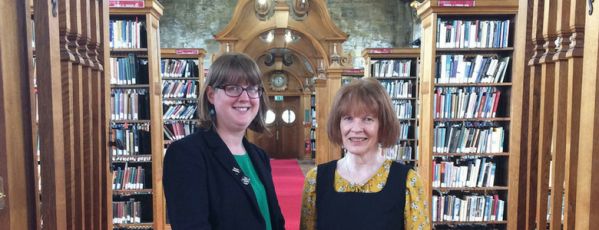
Kathryn Parry interviews Sue Hodges, former Director of Libraries and Archives, Bangor University. Sue talks about her career path, and her belief that with confidence and support you can go further than you might think, and achieve the career that you really want.

AS I start my new job as CILIP Wales Development Manager, I am making many new connections. I am struck by how many of these connections are with people who are at the opposite end of the career ladder to me. I see many experienced professionals retiring, but I cannot see much ­evidence of succession planning. How do we learn and carry forward the services these professionals have created? I want to hear how other professionals started out, what shaped their career and any advice they can give.

To gain more understanding of these issues, I recently interviewed Sue ­Hodges, who has just retired from her role as ­Director of Libraries and Archives at Bangor University. We talked about how her career developed, and how she aims to share what she has learnt over the years by mentoring and supporting people in their career plans.

Kathryn: How did you get into librarianship? 

Read more…