What hiring managers are really trying to figure out when they ask, ‘What are your hobbies?’

Jacquelyn Smith May 9, 2016

53118942_7600994ffe_b

Jeff Hitchcock/flickr

Don’t just say, “I love photography.” Explain why.

When you’re in the hot seat interviewing for a job, you’re answering questions such as “What’s your greatest weakness?” and “Why should we hire you?” — so a query like “What are your hobbies?” will probably seem like a piece of cake.

But before you start babbling about your lifelong obsession with horses or your newfound passion for baking, consider this: The hiring manager wants to get a better sense of who you are, so it’s important to think about which hobbies best showcase your strengths, passions, and skills — and then discuss only those in the interview.

“The employer is trying to determine whether you’d be a good fit, and getting insight into your interests, hobbies, and personality all help in evaluating that,” says Amy Hoover, president of the job board Talent Zoo.

Lynn Taylor, a national workplace expert and the author of “Tame Your Terrible Office Tyrant: How to Manage Childish Boss Behavior and Thrive in Your Job,” agrees: “By learning more about your outside interests, they can glean more about your personality, and even draw some conclusions about how you may thrive in the organization.”


Read more…

When People Ask for Career Advice, This Is What I Tell Them

Great mentors–and personal experience–have taught me some valuable lessons.

The Five Big Mistakes That Will Sink Your Internship This Summer

I have no qualms about saying that, for a host of reasons, I’m not a fan of internships and the emphasis we place on them as the best (and increasingly only) path to that elusive post-college entry-level white collar job. But, as a career advice Cassandra, I realize I’m in the minority. Interns are gonna intern. If your summer plans involve getting on-the-job experience (and a decent paycheck – please hold out for that) in the hope of increasing your future employability in a world in which the value of a college degree seems to erode by the year, you can at least go about it in the smartest manner possible. In other words, don’t make these mistakes.

Assuming Your Boss Knows What He/She Is Doing

It’s possible your manager hires interns because he or she deeply believes in nurturing the next generation of entrepreneurial or creative talent. It’s also possible that he or she has never managed anyone before, just needed an extra set of (cheap) hands around the office or was told from on high that the department would be getting an intern, end of story. The point being that it’s very unlikely that your growth and development will be this person’s top priority. Between putting out various fires, dealing with inter-office politics and daydreaming about an upcoming two weeks at a cabin in Maine, your boss likely won’t be devoting significant time to planning out your workload. Thinking your manager has your best interests at heart and relying on him or her to craft a winning internship experience on your behalf is a mistake. Read more…

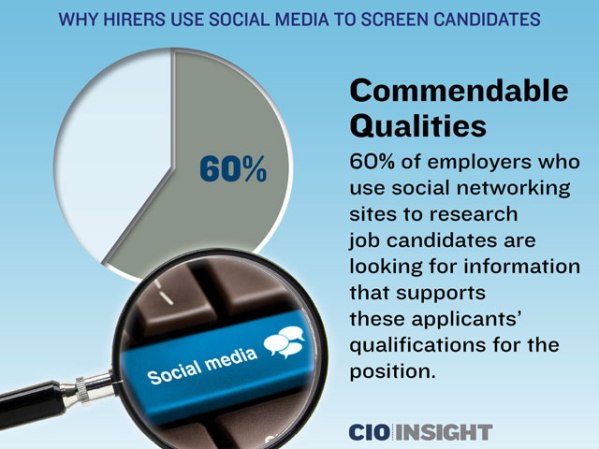
Why hirers use social media to screen candidates

by Dennis McCafferty Posted 054-29-2016

socialmeidascreen_5

Enter a caption

A growing number of CIOs and other hiring managers are screening job candidates by checking out their social media pages, according to a recent survey from CareerBuilder. These managers are also using search engines to research prospects—with many indicating that they’ll rule out applicants entirely if they couldn’t find any information about them online. Supervisors in the IT industry are most likely to turn to social media/search engines for research here, looking for details that supports candidates’ fitness for a vacancy as well as a professional online persona. A great deal of survey respondents admit that they’ve eliminated people from consideration based upon what they’ve found out about them online. As for the biggest deal-killers? These would include provocative/inappropriate photos and/or videos of the prospective hire, as well as the posting of discriminatory comments and any “bad mouthing” of an employer. “Tools such as Facebook and Twitter enable employers to get a glimpse of who candidates are outside the confines of a resume or cover letter,” said Rosemary Haefner, chief human resources officer of CareerBuilder. “And with more and more people using social media, it’s not unusual to see the usage for recruitment to grow as well.” More than 2,185 hiring managers and HR pros, as well as more than 3,030 workers, took part in the research, which was conducted by Harris Poll. – See more at: http://www.cioinsight.com/it-management/careers/slideshows/why-hirers-use-social-media-to-screen-candidates.html#sthash.a3jll3XB.dpuf


Lead From Where You Are

llfleadfromwhereyouare

Leading from where you are is about about recognizing your individual power and leading from whatever position you’re in.

We go through our entire lives being put into boxes – it’s how we create our identity. This is especially true at work. You get hired and you’re given a piece of paper that tells you what you do. The rest is vaguely described as ‘other duties as assigned.’

Source: Lead From Where You Are