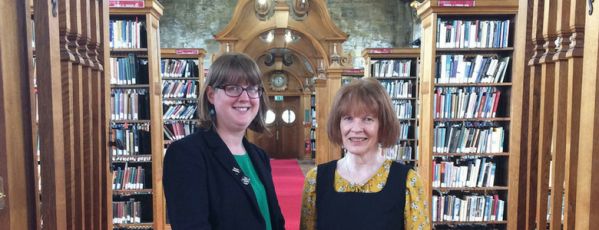
Competency Index for the Library Field 2014

Competencies | Career development | Library Skills

by Betha Gutsche and Brenda Hough, editors.

19 March 201521752988_10159605896755727_1299874495208785589_o


Looking to take your career to the next level? The Competency Index can help! See how 21st century skills, accountability, and community engagement can make a difference in your work. #WebJunctionWednesday http://bddy.me/2xfzafR

How to Bounce Back: 5 Resilience Building Strategies for Your Career | LinkedIn

Career advice | Resilience | Emotional Intelligence

by Dr. Marla Gottschalk January 24, 2017

aaeaaqaaaaaaaapwaaaajdvjzte4otdhlwqxztktngvhny1imwuxltq1ywfhngfimzqyoq

I’ve often wondered why building resilience isn’t a key business imperative. My opinion is such, primarily because being human, is often at odds with work life. Work can routinely bring stress, negativity, setbacks and outright failures — and most of us are challenged to combat the effects.

We often frame conversations about resilience with stories of extreme hardship or extenuating circumstances. However, resilience could serve as an ever-present, daily mentor, helping us to rebound from the collected pressures of work life. Most of us forge on — taking little note of the increasing toll — and building resilience isn’t considered.

This can be a serious mistake.

Through all of the trials and tribulation, we rarely notice that our psychological resources are waning.We muddle on. We develop idiosyncratic mechanisms to bolster our mood and maintain motivation. However, the damage accumulates. We become less able to bounce back. Months later, we may realize that we still lament the project that has been cut, laid off co-workers or failing to land an important client. Read more…


Sharing learning from an inspiring professional career

Mentoring | Coaching | Leadership | Management | Academic Libraries

by Kerry Parry 31 August 2017

sharing_learning_banner

Kathryn Parry interviews Sue Hodges, former Director of Libraries and Archives, Bangor University. Sue talks about her career path, and her belief that with confidence and support you can go further than you might think, and achieve the career that you really want.

AS I start my new job as CILIP Wales Development Manager, I am making many new connections. I am struck by how many of these connections are with people who are at the opposite end of the career ladder to me. I see many experienced professionals retiring, but I cannot see much ­evidence of succession planning. How do we learn and carry forward the services these professionals have created? I want to hear how other professionals started out, what shaped their career and any advice they can give.

To gain more understanding of these issues, I recently interviewed Sue ­Hodges, who has just retired from her role as ­Director of Libraries and Archives at Bangor University. We talked about how her career developed, and how she aims to share what she has learnt over the years by mentoring and supporting people in their career plans.

Kathryn: How did you get into librarianship? 

Read more…

A New Study Says Anxiety Can Help You Perform Better — But Only If You Know How To Respond To It

Emotional Intelligence | Mental Health | Career Advice

Amy Morin, contributor Forbes August 12, 2017

960x0

Shutterstock

Anxiety is probably the most common reason people enter my therapy office. From specific phobias to generalized anxiety disorders, people are often desperate to do whatever it takes to get rid of their discomfort.

While you may not have a diagnosable anxiety disorder, there’s no doubt you experience anxiety sometimes. Whether the thought of giving a speech makes your heart race or your fear of asking for a raise leaves your palms sweaty, anxious feelings are normal.

In an effort to spare yourself from anxiety, you might decline to take a risk or decide to stay inside your comfort zone. After all, anxiety is uncomfortable and an easy way to prevent it is to avoid anything anxiety-provoking.

But new research shows anxiety isn’t always harmful. In fact, it could improve your performance if you know how to respond to it. Read more…


Librarians of the 21st: The Ultimate Superheroes of Research

Librarians | Archives | Career advice

Stefanie Maclin-Hurd | June 15, 2017

research

There’s a reason why, when you meet a librarian for the first time, she sometimes looks hesitant to tell you what she does for a living—we’re far too used to sharing our profession and hearing that libraries are dead because of Google. (They’re always shocked to hear that libraries are actually far more alive because of Google.) And even regular library patrons are sometimes shocked by the amount of research and reference that are part of a library’s daily work. In this essay, Stefanie Maclin-Hurd uses her wide range of library jobs to demonstrate that for all its changes, librarianship in the 21st century is still very much about research.

–Stephanie Anderson

I learned research before I learned to catalog, if one considers digging through websites as a high school student to be research. When considering the whys of being a librarian, research was something I knew I wanted to do. Not just because I loved to learn, but because I needed to know the reasons why behind each thing I learned. If I read a book, I needed to know what was true and what was enhanced, and research was the way to do it. In learning how to be a librarian, this need to know, this thirst for knowledge, was welcome. I studied archives in library school, and loved that I was able to search for the meanings and history behind the objects I was studying. Research is something which has followed me into every library and every archives job I’ve held. Research has made me a better librarian. Read article