The Myth and the Reality of the Evolving Patron | American Libraries Magazine

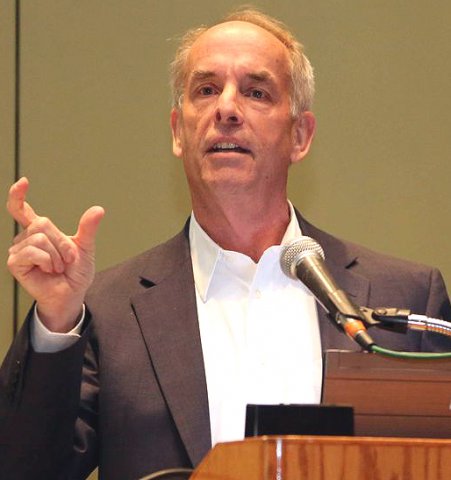
Lee Rainie, director of the Pew Internet and American Life Project

By Brita Zitin

The Scoop

Lee Rainie

Lee Rainie, director of the Pew Internet and American Life Project, knows how to win over a roomful of librarians, as he proved at the RUSA President’s Program, where he was the keynote speaker. He’s generous with both his flattery (“Every day spent with librarians is a good day”) and his cat photos (the feline census of his slideshow reached well into the double digits). But he also delivers—in abundance—what information professionals really want: reliable data that makes library work more meaningful.

The research pursued by Rainie and his colleagues at the Pew Internet and American Life Project covers library use on the national level and cannot substitute for insight into a particular community gathered through the kind of deep listening advocated by the Harwood Institute [http://www.ala.org/transforminglibraries/libraries-transforming-communities]. Still, Rainie has a talent for translating these broad strokes into practical tips. Drawing on Pew’s recent report “Parents, Children, Libraries, and Reading,” he said, “If you want to figure out who loves you most, it’s parents of minor children, and within that, the moms. Romance the moms.” Read more…

via The Myth and the Reality of the Evolving Patron | American Libraries Magazine.

40 Great Apps for Mobile Reference and Outreach | American Libraries Magazine

40 Great Apps for Mobile Reference and OutreachBy Sanhita SinhaRoy

via 40 Great Apps for Mobile Reference and Outreach | American Libraries Magazine.

Mobile phone apps

The desire to learn about useful mobile apps is rampant among librarians, judging by the overflow crowd at Sunday’s Conversation Starter billed to deliver ““40 Great Apps for Mobile Reference and Outreach.”

More than 200 conference-goers packed the small room booked for the session, with many peering through the doorway and sitting on the floor. During their presentation, branch manager Richard Le and adult services librarian Mel Gooch, both from San Francisco Public Library, shared what they have found to be dozens of apps that provide innovative services, useful mobile content, and opportunities for outreach.

Here’s the full list of the 40 apps they discussed, as well as some suggestions Le and Gooch provided for ways in which librarians can explore and integrate them into their library’s mobile strategy. They range from the more obvious (Amazon, Google Maps, and Dropbox) to the more obscure (EasyBib, SitOrSquat, and SportsTap). Most are compatible with both Android and iOS (Apple) devices, and all are free unless otherwise noted: Read more….

Enhanced by Zemanta

New PEW: Younger Americans’ Library Habits and Expectations – Stephen’s Lighthouse

New PEW: Younger Americans’ Library Habits and Expectations – Stephen’s Lighthouse.

Younger Americans’ Library Habits and Expectations

by , and

Summary of Findings

http://libraries.pewinternet.org/2013/06/25/younger-americans-library-services/?utm_source=rss&utm_medium=rss&utm_campaign=younger-americans-library-services

Younger Americans—those ages 16-29—exhibit a fascinating mix of habits and preferences when it comes to reading, libraries, and technology. Almost all Americans under age 30 are online, and they are more likely than older patrons to use libraries’ computer and internet connections; however, they are also still closely bound to print, as three-quarters (75%) of younger Americans say they have read at least one book in print in the past year, compared with 64% of adults ages 30 and older.

Similarly, younger Americans’ library usage reflect a blend of traditional and technological services. Americans under age 30 are just as likely as older adults to visit the library, and once there they borrow print books and browse the shelves at similar rates. Large majorities of those under age 30 say it is  “very important” for libraries to have librarians as well as books for borrowing, and relatively few think that libraries should automate most library services, move most services online, or move print books out of public areas.

At the same time, younger library visitors are more likely than older patrons to access the library’s internet or computers or use the library’s research resources, such as databases. And younger patrons are also significantly more likely than those ages 30 and older to use the library as a study or “hang out” space: 60% of younger patrons say they go to the library to study, sit and read, or watch or listen to media, significantly more than the 45% of older patrons who do this. And a majority of Americans of all age groups say libraries should have more comfortable spaces for reading, working, and relaxing. Read more….

So You Think You Want to Be a Librarian?

Most people’s knowledge of librarianship is a mash-up of Katherine Hepburn and Spencer Tracy in Desk Set, some warm and fuzzy memories from an elementary school class visit, Rupert Giles from Buffy the Vampire Slayer, even fuzzier memories of all-nighters in their college libraries, and maybe a high-minded article or two about the Digital Public Library of America.

If this sounds familiar, don’t be embarrassed. Librarianship is a notoriously opaque profession, and most Americans have about as much understanding of what we do as they have of cloistered nuns, or actuaries.

Here’s the first shocker: most professional-level library positions require a masters in library or information science, most commonly known as “the M.L.S.” Since the M.L.S. involves a serious commitment of time and money, then you better be doubly sure that this is the right decision, at least for the next decade or two. Read more…


Enhanced by Zemanta

Library Learning Goes Online – YouTube

American Libraries Live—online learning is changing the way schools work. From elementary to graduate school to continuing education, online tools are creating new horizons in distance learning and new tools to supplement in-person learning. But what does this mean for libraries?

Sarah Steiner, Social Work and Virtual Services Librarian at Georgia State University Library will lead our expert panel:

  • John Shank, Instructional Design Librarian and Associate Director of the Center for Learning and Teaching at Penn State University
  • Lauren Pressley, Head of Instruction at Wake Forest University Libraries